Other opposing coaches may not have echoed the “mystique” theory, but many came into their contests with Wahoo carrying baggage similar to Raymond Central. When Wahoo began the ’93-’94 season the team had a regular season win streak of 105 games. Needless to say, the other Capitol Conference schools had a hard time remembering the last time they defeated a Wahoo team. While Raymond Central’s experience was the extreme case, the other schools had their share of bad memories.
Ashland had lost all 10 games to the Warriors from 1987 to 1993. In 1993 Coach Kent Kingston had grasped at the straw of the “cherry picker” and the “clam shell” to try and slow down the Warriors and the Blue Jays were still soundly defeated. When Ashland visited Wahoo in February of 1994, Wahoo easily tacked on win #11. It was a Mustang like experience as Wahoo led by 18 at the end of the first quarter and the lead increased to 31, then 41, and finally 43 by game’s end. It was a game in which Wahoo struggled from the three point area, connecting on only four of twenty-two attempts. But it made no difference as Ashland committed 25 turnovers with the Warriors recording 19 steals. Coach Kingston reflected, “They put incredible amounts of pressure on you and it can get to you after awhile.”
Part of the baggage teams brought with them to their games with Wahoo was the low expectations coaches sometimes had – low expectations based on past experience. The Warriors had prevailed over Arlington for the last 8 times they competed and Wahoo came away with another victory when they travelled to Arlington in December. Most of the time, when a team gets beat by over 20 points, the coach isn’t too happy. True, Arlington dropped a 90 – 69 decision to the Warriors, but the 69 points was the third most points scored against a Wahoo team in seven seasons. Most coaches probably thought if they could have a hot night shooting, maybe, just maybe they could compete with Wahoo. The Eagles made ten of twenty-two three’s that night. But even that wasn’t enough (Wahoo actually matched that three point output). Even after a 21 point loss, Arlington coach, Jeff Rippe said, “I was pleased with the way we competed well tonight.”
Of the nonconference schools Wahoo had played over the previous six years, Schuyler suffered the most, facing Wahoo once each season in the regular season and four times in the holiday tournament. The average margin of victory for Wahoo over that span was 32 points. And, like Raymond Central, the recent experiences had been particularly bad, losing to Wahoo twice in 1992,by 26 and 27 points, and then getting totally blown out in 1993 by 58 and 60 points. The 1994 experience was to be more of the same. In fact, the first encounter was even more of a nightmare – added to the usual Wahoo pressure defense was a very hot shooting night for the Warriors. Wahoo connected on eleven three point shots out of 19 attempts, five of the eleven coming in the first quarter as Wahoo finished the quarter ahead by 34 points, 44 – 10. Louie Wotipka, Josh Anderson, and Mike Simons each made a three. Mike Hancock sank two treys and finished the quarter with 15 points. Sean Forbes added a three in the second period and Hancock had another as the Wahoo lead increased to 65 – 21. And just to show off the team’s diversity, Wahoo’s inside threat, Travis Toline scored 11 in the third period and the Warriors pushed the lead to 51 points. The starters sat the fourth quarter and reserves continued the three point barrage as Josh Anderson and Chris Anderson each posted a three while Forbes added another pair. The bench produced 31 fourth quarter points and Wahoo registered a 115 – 54 win. Schuyler coach Jeff Droge reflected on his team’s performance: “We missed some bunnies early and we were pretty nervous.” This was the championship game of a holiday tournament, not a district, or even a conference final, so perhaps the Schuyler coach’s comment was a product of the “mystique.” It certainly was an admission that the his team brought some negative baggage to the game with them as he added, “We’ve been in this situation with Wahoo before. You have to try to settle down and run your offense.”
Schuyler’s second game with the Warriors came in the final weekend of the regular season as the other Warriors travelled to Wahoo for a rematch. It was, for the most part, more of the same. Although Wahoo’s first quarter wasn’t as productive, it was still a killer as Wahoo converted 14 first quarter turnovers to establish a 24 – 10 lead. Greg Hain led the first quarter push with 10 points. Then, in the second period, the same three point shower that had doomed Schuyler in the first outing struck again. Part of a 15 point quarter, Hancock scored four treys, while Josh Anderson and Forbes each knocked in one. The result was a 54 – 23 lead at the half, and there was no doubt Wahoo was on their way to another dominating win. In the end, the reserves didn’t fare as well as in the first contest and Schuyler was able to outscore the Warriors 22 – 13 in the final stanza, but it was still a 90 – 52 Wahoo victory. Coach Droge had hoped for better, but his post game comment is somewhat revealing of a pregame sentiment: “At halftime, we hoped to be within 12 or 13, then a lot of crazy things can happen.” In other words, the goal was to be down by double digits and then hope for “crazy.” There was certainly some baggage there.
Other teams had baggage as well. After losing to the Warriors by 62 points in the holiday tournament of 1987, Aquinas had found better ways to spend the holidays, but still had played the Warriors every year in a regular season game. The Monarchs might have been “mystique proof” after actually holding a five point half time lead in 1992, and eventually losing by only 8 (72 – 64). But in 1993, it was back to business as usual and the Warriors swatted away the Monarchs 97 – 45. After losing to Wahoo in 1994, Aquinas coach, Kevin Scheef, echoed his feelings from the previous year: “It’s a tough chore to get the ball over half court.” Logan View was another team that might have benefitted from some small success, also coming close against the 1992 Warriors, losing by only 11. But again, 1993 had not been kind – an 82 - 41 loss. And 1994 confirmed the Wahoo superiority with a 104 – 46 loss.
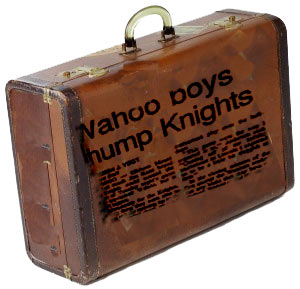
Elkhorn Mt. Michael was probably Wahoo’s opponent over the seven year stretch with the least baggage as the Knights had been one of the most competitive teams on Wahoo’s schedule. Mt. Michael had played Wahoo eight times, six regular season, one district tournament game, and once in the state tournament. The average losing margin for the Knights was a respectable (?) 23 points. In four of the regular seasons, the Knights had been beaten by less that twenty, coming its closest in 1992, losing by only 7 on Wahoo’s home court. The Knights suffered their worse loss to Wahoo in 1993, an 83 – 45 Warrior win. In 1994, Elkhorn was one of Wahoo’s more competitive games, coming closer than all but Arlington and GICC of Wahoo’s regular season opponents. But Wahoo still won decisively, 85 – 57. The Knight’s veteran coach, Jim Kane commented on Wahoo’s success: “The one thing you don’t want to do is let their pressure get to you … but pretty soon you look up and it’s a seven-point game, then it’s a 12-point game, and you can’t stop them.” The “pressure getting to you;” perhaps that’s part of the “mystique.”
The “baggage” was evident from other coaching comments in 1994, as Syracuse coach Mark Hrabik noted, “I knew they were going to get layups off their press and transition game. We just had to cut down on the number of them and we didn’t. (Wahoo won 86 – 43.) Conestoga’s coach Terry Criger: “We knew we had an uphill battle.” It was an 86 – 51 win in which Wahoo forced 31 Cougar turnovers. Valley coach Charlie Doeden after a 98 – 45 loss to Wahoo: “We can’t stay with them.”
The only teams that had no baggage were the newbies on the Wahoo schedule. Seward had added the Wahoo game in 1993 and had now lost twice, each by over 40 points. The Bluejays were starting to accumulate baggage. The latest addition to the regular season was Grand Island Central Catholic who Wahoo played in the final game. It was obvious that the Crusaders had no baggage – a writer from the Grand Island Independent predicted a one point GICC victory. The Crusaders would prove to be one of the more competitive teams Wahoo faced, but not that competitive (93 – 77).
If the “mystique theory” had any validity it was from the baggage that all the past experiences produced for Wahoo opponents. As the ’93-’94 season moved forward, it probably got harder for coaches to get the players to buy into any “it’s a new year” type of speech as Wahoo was again racking up 30 plus point wins. The expectations of opponents often became a self-fulfilling prophecy. Teams facing Wahoo saw a “powerful” opponent and the Warriors were quite capable of taking advantage of any team’s trepidations. Opposing coaches, players, and fans often held the Wahoo team in awe …. “mystique.”