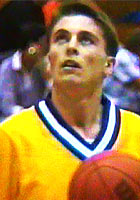
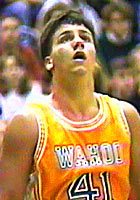
As the lone returning starter, Simons was the focal point of the 1992 “rebuilding.” The stat line from 1991 might not have generated much confidence in the senior’s ability to propel his ‘92 team to the level of its predecessors. As a junior, Jeff had averaged 6.3 points and 5 rebounds; not bad, but not marks that projected to championship expectations. However, the 2.5 steals and 50% three point shooting (64 / 128) revealed some potential. In a post season interview in 1991, Simons had indicated he would be looking to be more of a scorer in ‘92 and Coach Anderson endorsed his senior leader in a preseason interview in which he indicated that “Jeff has been shooting the ball very well in practice and we feel confident that he can continue to do so.” Simons would not disappoint his coach as he would average 15 points. And the senior captain would put up 3.5 steals from his wing position in the renowned Wahoo 1-3-1 zone.
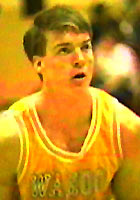
Trent Toline had started several games in 1991 and was the inside sub for the Warriors undefeated team. He had averaged 9.2 points and 5.8 rebounds , shooting 58% from the field. The 6’5” senior was the heir to the Wahoo inside game that had traditionally been a dominant force. In his senior year, Trent would start all the games and up his scoring average to 16.3 while maintaining his fieldgoal percentage. Playing the middle of the Wahoo zone, Toline averaged 5.5 rebounds.
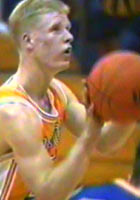
Joel Weyand started a number of games in the middle of the 1991 season and would be stepping into the point guard position that had been manned by Troy Glock and Ryan Eddie during the Warriors championship runs. With big shoes to fill (both Glock and Eddie were going on to play small college basketball at Nebraska Wesleyan and Midland respectively), Weyand brought some impressive stats to the 1992 table with an 8.8 scoring average from ‘91 along with 3.5 assists and 2.5 steals and a 56% shooting percentage. As a full time starter in 1992, Joel would average 14.7 points, continuing to shoot over 50%. Joel’s assist average would increase to 5.6 and he would average 2.9 steals per game from his point position on the 1-3-1.
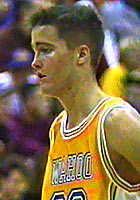
Justin Anderson got the nod as another perimeter starter after averaging 4.8 points in 1991. He had shot 49% on three pointers (40 / 82). Justin would be the fourth Warrior to average double figures in ‘92 with 12 points and his three point shooting would continue to sizzle at a 48% rate (30/79)). Playing the wing opposite Simons, Justin would average 4.2 rebounds.
Ryan Glock claimed the starting position on the baseline of the 1-3-1. Glock had the least varsity experience of the new starters and won his position as the “role player” that Anderson coached teams had always produced, in the tradition of Cliff Kreizel, Rob Brigham, Troy Johnston and Jeff Simons during his junior year. And while Glock’s play in that position would be productive, he would eventually be supplanted by a scoring machine that was tough to keep out of the starting group.
In evaluating his new lineup, Coach Anderson noted that “this group has been waiting for its chance.” That was indeed true, as the 1992 Warriors knew they were perceived as being less of a team than the ones that had won four consecutive Class B titles and produced a 90 game win streak. Individually, they were somewhat unknown. The previous March, Simons, Toline, Weyand and Anderson had all tried out for the Nebraska Basketball Development Association team. A disappointed group drove home from the University of Nebraska Omaha fieldhouse as none even made it to the final group that night. When the team competed that summer at the University of Nebraska team camp, soundly defeating several Class A teams, an opposing coach would ask where these guys were during the NBDA tryouts. Coach Anderson would reply with a slight smile, “they got cut.” The 1992 Warriors were a talented group of “inexperienced” players who Stu Pospisil of the Omaha World Herald portrayed as “understudies in that long running production called Wahoo,” who had a little chip on their shoulders and were ready for what Stu Pospisil called their “starring roles.”