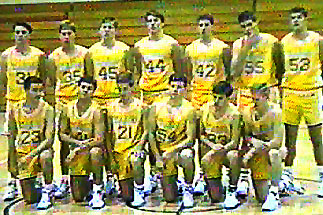
| The “rebuilding” process of 1992 for Wahoo might have been easy if it was just a matter of moving juniors up to fill the positions vacated by 1991’s seniors. Or maybe it could have been as easy as just putting the players out on the court that had the best stats from 1991. But building a championship team is more like putting together a jigsaw puzzle -- finding just the right piece to fit in just the right place. . All coaches deal with the issue of playing underclassmen. Some have an iron clad rule that freshmen don’t play with the varsity. Some coaches are prone to play the upperclassmen as they usually are the ones expecting to get the playing time -- they’ve “paid their dues” -- and playing juniors and seniors rarely generates any friction in the locker room. Other coaches profess a “play the best players” philosophy and eschew any notion that upperclassmen be given any preference.
Under Coach Anderson, the Wahoo program projects a blurry picture. There had certainly been freshmen who contributed at the varsity level -- during the championship years, Troy and Jason Glock immediately come to mind. On the other side of the coin, there were seniors who remained an integral part of Anderson coached teams even in the absence of statistical contributions. Names like Cliff Kreizel, Rob Brigham, and Troy Johnston come to mind. But there were also seniors who spent most of their time playing only in clean up time. So, when asked whether the Wahoo program would use underclassmen or stay with the seniors, the answer had to be “it depends.”
Of course, that prompts the next question, “Depends on what?” Coach Anderson’s preseason comments about the 1992 team’s prospects provide some insight. First of all, on numerous occasions, Anderson referred to the collective group on the Warrior roster in 1992 as having “waited their turn.” Anderson was acknowledging that these players had been competing at a high level, but whether it was a matter of getting into the starting lineup, getting opportunities off the bench, or even just getting into a varsity uniform, they had been forced to stay patient as the players “ahead” of them were not easily displaced. Indeed, it was often commented that players at the bottom of the varsity ladder in Wahoo could have started for many of Wahoo’s opponents. Secondly, Coach Anderson always emphasized the team aspect: “Finding the right roles for each of these players is what is going to be important. We want the team to benefit most from their individual roles.” This, combined with the consistent emphasis Anderson placed on defense, led to many occasions where one player was elevated over another even though the player ending up on the bench might very well have been able to easily defeat his starting counterpart in any game of one-on-one.
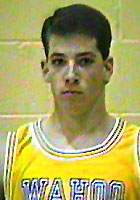
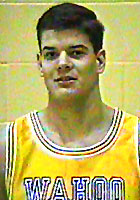
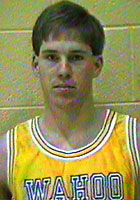
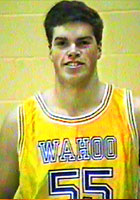
The view from outside the Wahoo program in the fall of 1991 saw seniors Jeff Simons and Trent Toline as obvious varsity starters. Juniors Joel Weyand and Justin Anderson, based on previous varsity and junior varsity performances were generally viewed as probable starters. The fifth position was more uncertain. There were some seniors who Coach Anderson might have turned to -- Todd Kaiser and Keith Klemme would provide some size to a lineup considerably shorter than in previous years (Trent Toline being the only starter over 6’2”). Junior Sean Brennan, who had led the junior varsity in scoring the previous season, and sophomore Travis Toline were also candidates to provide a taller Warrior lineup. But the Wahoo championships had been won with the 1-3-1 zone defense that required a particular skill set. It helped to have size on the wings, but those wing players also needed to be mobile. Jeff Simons and Justin Anderson provided that mobility and were bona fide scorers -- they locked down the wing positions. Trent Toline anchored the middle. Those decisions relegated Kaiser, Klemme, Brennan and Travis Toline to competing for substitute roles on the wings and in the middle. Jeremy Herrmann, a 6’2” senior and Ryan Glock, a 6’1” junior were vying for a spot as starters, but neither could challenge Weyand for the point guard position. That left the baseline of the 1-3-1 open for competition. The baseline might be the most challenging position in the 1-3-1 as it requires a player that can cover corner to corner, can defend inside, and can rebound. Ultimately, Ryan Glock got the nod as the coaches saw the junior as a strong defender and a player who would hustle that baseline. It was a difficult decision because it placed three seniors (Kaiser, Klemme and Herrmann) on the bench and it presented at least the potential for a divided locker room. But the players managed to eventually accept their roles and as once again the Warriors dominated opponents, there was playing time for all. The most important thing was that the team was winning -- the pieces fit.
|